Warm tropical water
Stable tropical conditions allow corals to grow year round, creating complex reef structures and long-lived habitats.
Destinations
The global centre of marine biodiversity and the reason so many of the world's best macro diving destinations sit close together.
The Coral Triangle is a vast marine region in Southeast Asia and the western Pacific. It is often described as the ocean equivalent of the Amazon rainforest because it contains the highest concentration of marine biodiversity on Earth.
Quick Intro
This infographic gives a quick visual overview of the region, the countries it includes and why it is so important for coral reefs, macro life and nudibranch diversity.
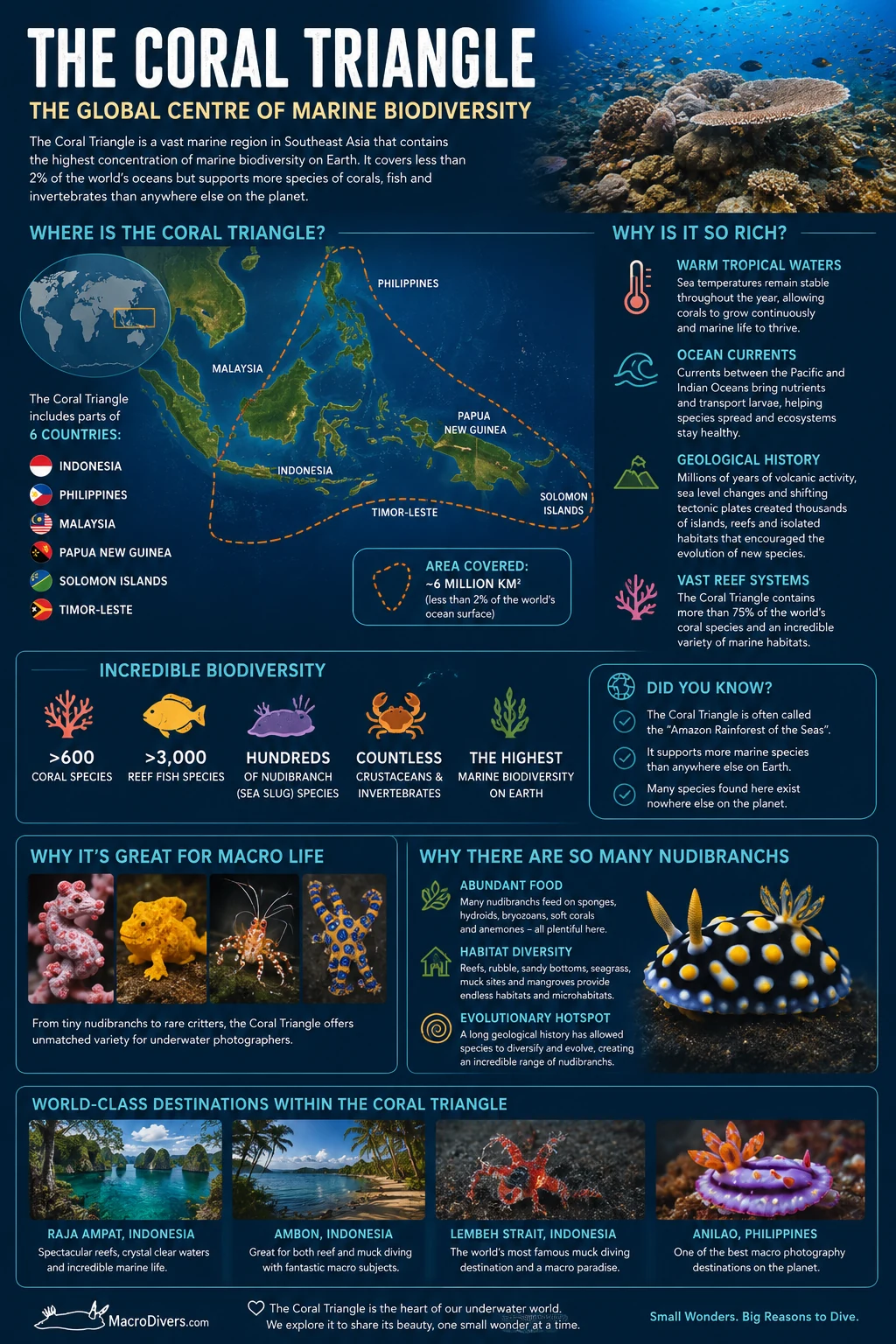
The Coral Triangle includes parts of six countries: Indonesia, the Philippines, Malaysia, Papua New Guinea, Solomon Islands and Timor-Leste. Within this region are thousands of islands, reefs, channels, walls, seagrass beds, mangroves, rubble slopes and muck diving habitats.
Stable tropical conditions allow corals to grow year round, creating complex reef structures and long-lived habitats.
Currents moving between the Pacific and Indian Oceans carry nutrients, larvae and genetic diversity through the region.
Volcanic islands, changing sea levels and tectonic history created countless isolated habitats where species could diversify.
Reef walls, slopes, lagoons, sand, rubble, mangroves and muck sites all provide different homes for different animals.
Healthy reefs support sponges, hydroids, tunicates, soft corals and algae, which in turn support specialised macro life.
Over long periods of time, isolation and reconnection helped create an exceptional concentration of species.
Macro life thrives where there is structure, food and variety. The Coral Triangle has all three. Every reef surface, sponge, hydroid, coral head, algae patch and rubble slope can become a specialised habitat for small creatures.
Nudibranchs are closely linked to their food sources. Many feed on sponges, hydroids, tunicates, bryozoans, soft corals or other small animals. Because the Coral Triangle has such a huge variety of these prey species, it also supports an extraordinary variety of nudibranchs and sea slugs.
This is why places such as Raja Ampat, Ambon, Lembeh and Anilao are so productive for underwater macro photographers. The diversity is not accidental. It is the result of warm water, complex habitats, strong currents, deep geological history and a vast supply of specialised food sources.
Huge reefs, exceptional fish life and superb coral diversity.
A productive mix of reef, critter and muck diving habitats.
One of the world's best destinations for macro photography and nudibranchs.
The Coral Triangle sits at the heart of what MacroDivers is about: small subjects, extraordinary biodiversity and dive destinations where every slow look at the reef can reveal something new.